AI Agents for Business in 2026: 7 Answers for SMBs
AI agents for business in 2026: what an AI agent is, what it costs, which providers suit small businesses, and how to get started without wasting money.
 Sindre Fjellestad · 7 min read
In this article (10)
An AI agent for business is software that can carry out tasks autonomously, not just answer questions. In 2026 three big providers dominate: ChatGPT Workspace Agents (launched 22 April), Microsoft Copilot Studio and Anthropic's Claude Agent SDK. On top of that come businesses that build their own, as we did with Nora.
For small and medium-sized businesses (SMBs) in Norway, an AI agent for business is no longer a future trend. It is a practical tool you can start using tonight. The question is which AI agent for business suits your company, and how to get started without wasting money.
What is an AI agent for business?
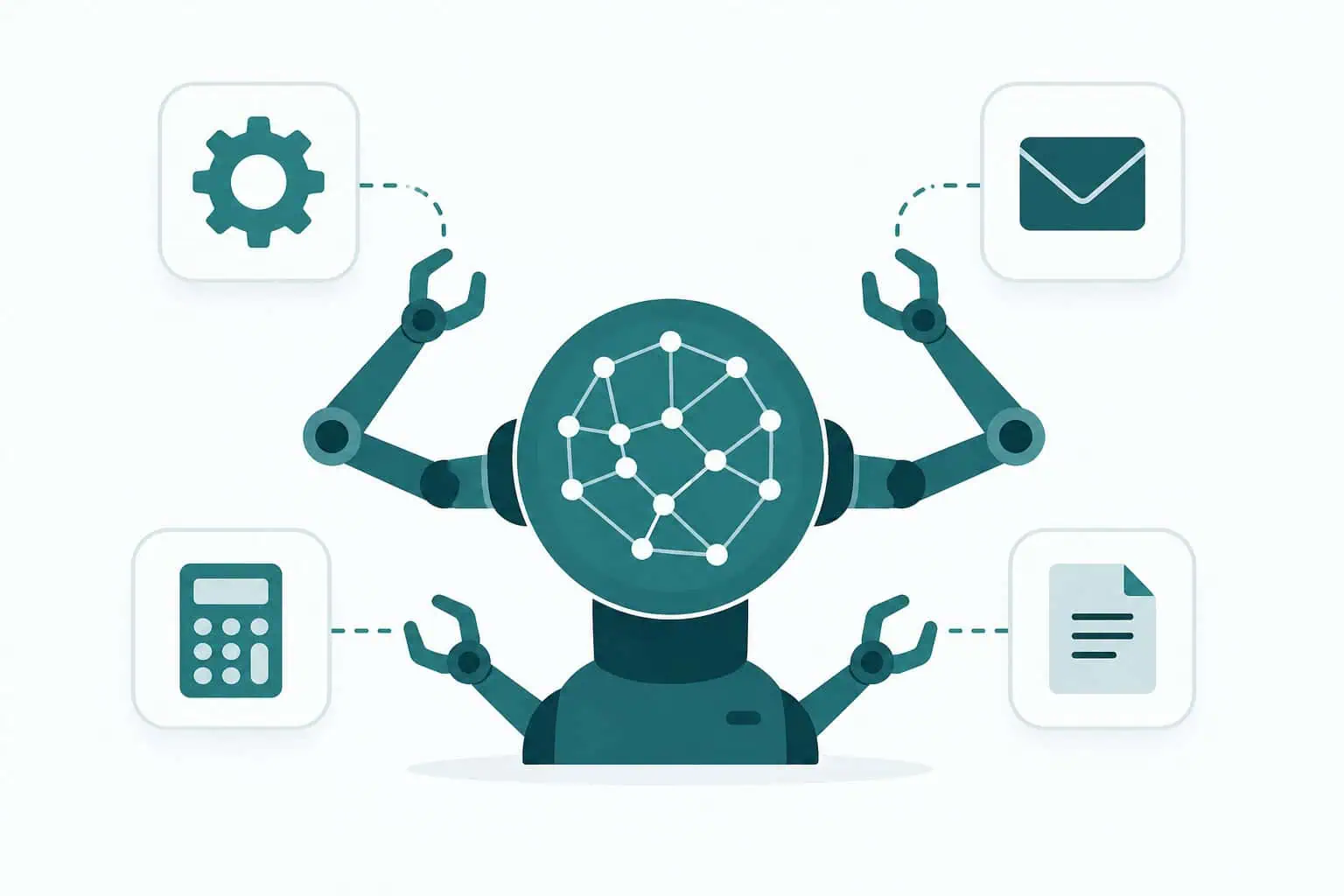
An AI agent for business is autonomous software that can reason, take actions and complete tasks with minimal human direction. It differs from an ordinary AI chatbot or assistant in that it acts, not just talks.
Three key properties define a modern AI agent for business in 2026:
- Autonomy: it can run tasks without a user being logged in
- Tool use: it can call external tools (email, CRM, spreadsheets, APIs)
- Persistence: it remembers context across several sessions and tasks
In practice this means that an AI agent for business can, for example, read incoming emails, categorise them, create tasks in Notion, send follow-up emails and report status to the management team, all on a Sunday when the office is closed.
AI agent vs AI chatbot vs AI assistant
The terms are often mixed up. This is how they differ:
| Type | What it does | Example |
|---|---|---|
| AI assistant | Answers questions, passive | ChatGPT (ordinary chat) |
| AI chatbot | Answers customers on your website | Earlier generation of customer service bot |
| AI agent | Reasons, takes actions, connects to tools | ChatGPT Workspace Agent, Claude Agent, Nora |
For SMBs the difference matters because pricing, use cases and the choice of provider differ. An AI agent for business is typically more expensive per user than an assistant, but delivers much more work per hour.
The main providers in 2026
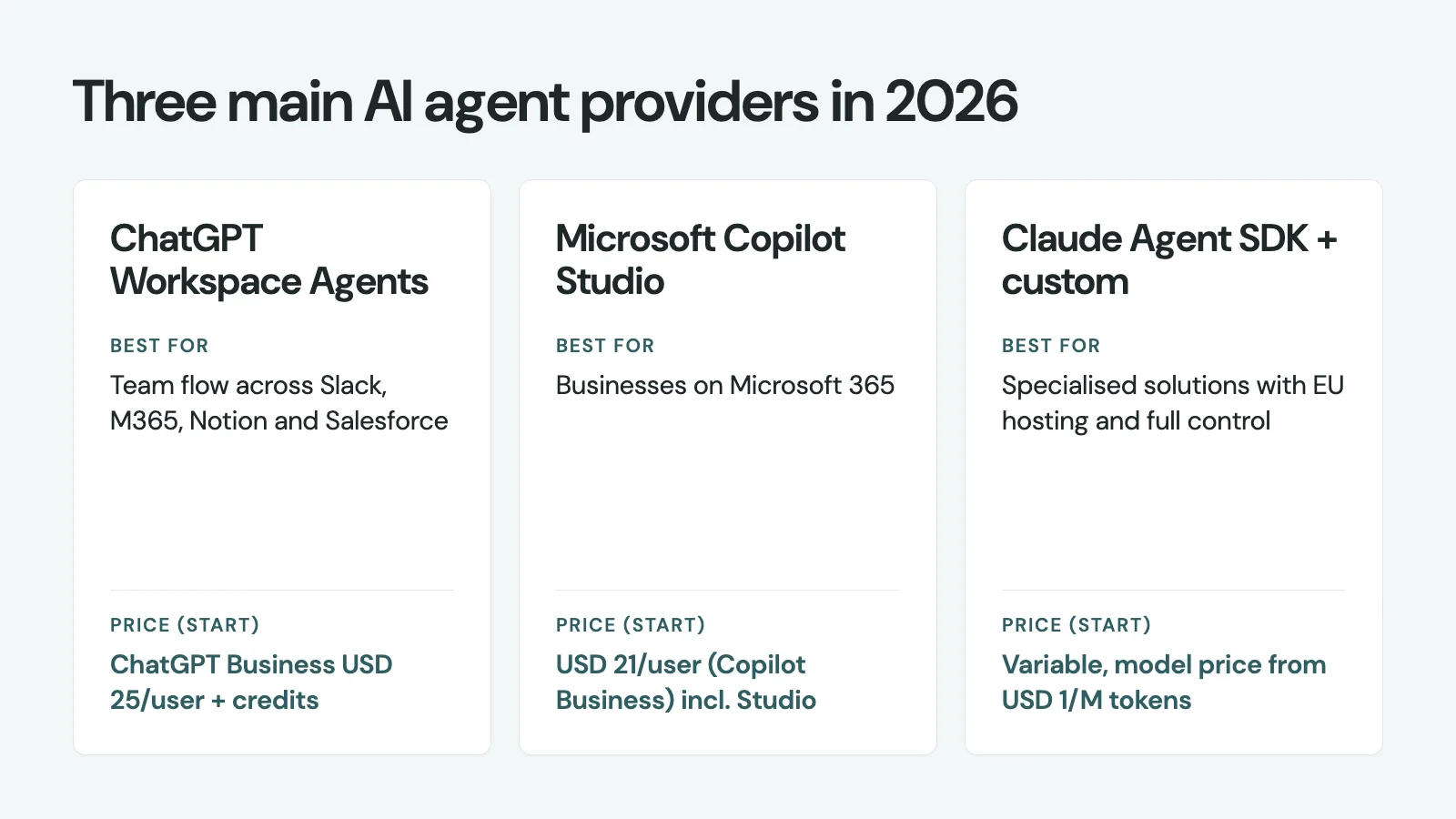
Three providers cover around 90% of the AI agent market for SMBs in Norway:
| Provider | Best for | Price (start) |
|---|---|---|
| ChatGPT Workspace Agents | Team flow across Slack, M365, Notion, Salesforce | ChatGPT Business USD 25/user + credits |
| Microsoft Copilot Studio | Businesses on Microsoft 365 | USD 21/user (Copilot Business) incl. Studio |
| Claude Agent SDK + custom | Specialised solutions with EU hosting and full control | Variable, model price from USD 1/M tokens |
There are also Google Vertex AI Agents (strong if you are on Google Cloud), Salesforce Einstein 1 Agents (Salesforce stack only), and open frameworks such as LangChain.
For most SMBs the choice is between the three big ones.
What does an AI agent for business cost?
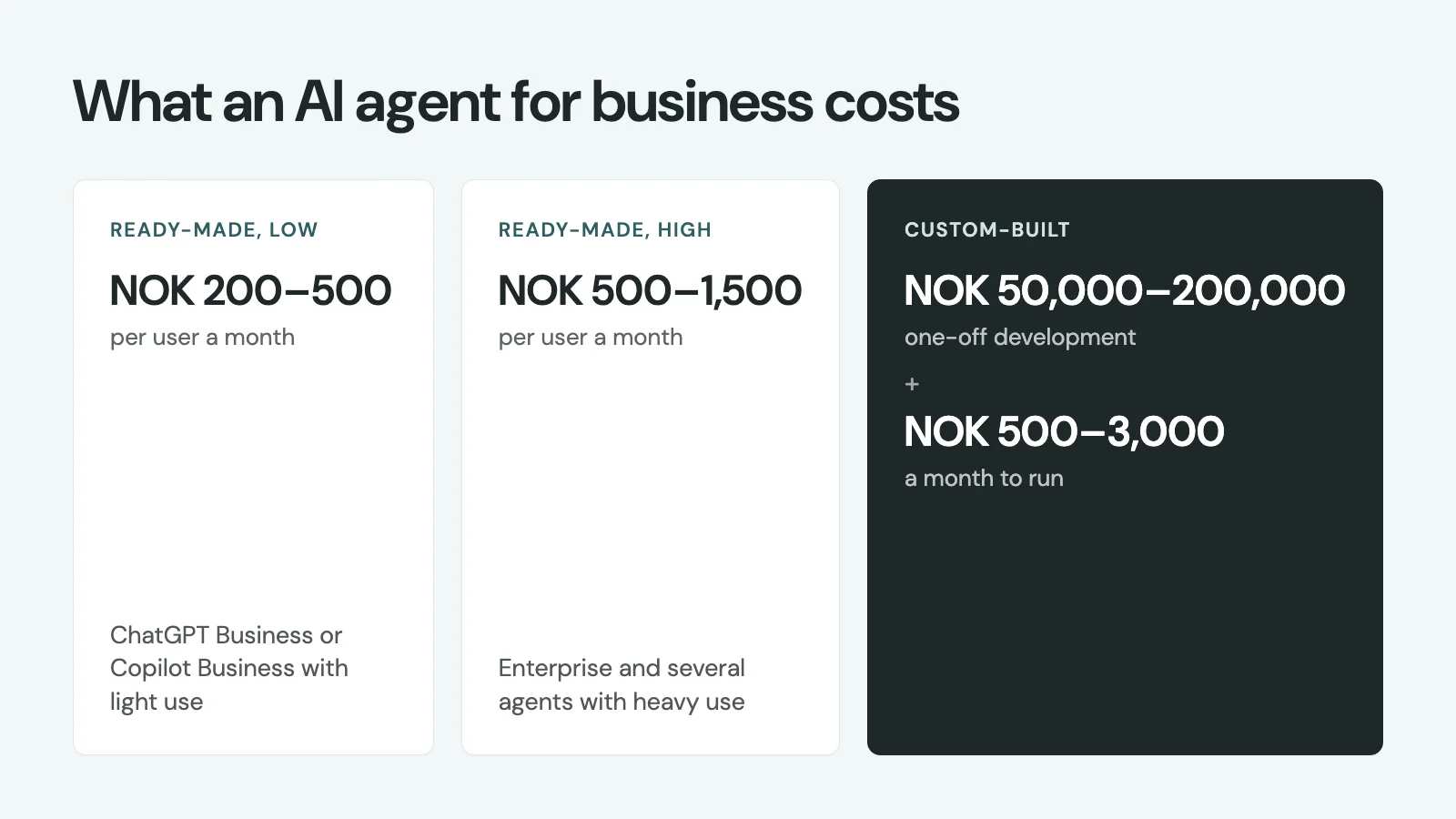
The price of an AI agent for business depends on three things: licence (ChatGPT/M365), usage (credits or tokens), and development (no-code, custom, in-house).
Three price levels to expect (in Norwegian kroner):
- Ready-made, low level: NOK 200–500 per user a month (ChatGPT Business or Copilot Business + light use)
- Ready-made, high level: NOK 500–1,500 per user a month (Enterprise + several agents with heavy use)
- Custom-built: NOK 50,000–200,000 one-off development + NOK 500–3,000 a month to run
The last category is where an AI agent for business can deliver the most unique value, but also where it is easiest to waste money without a good partner.
5 common use cases for SMBs
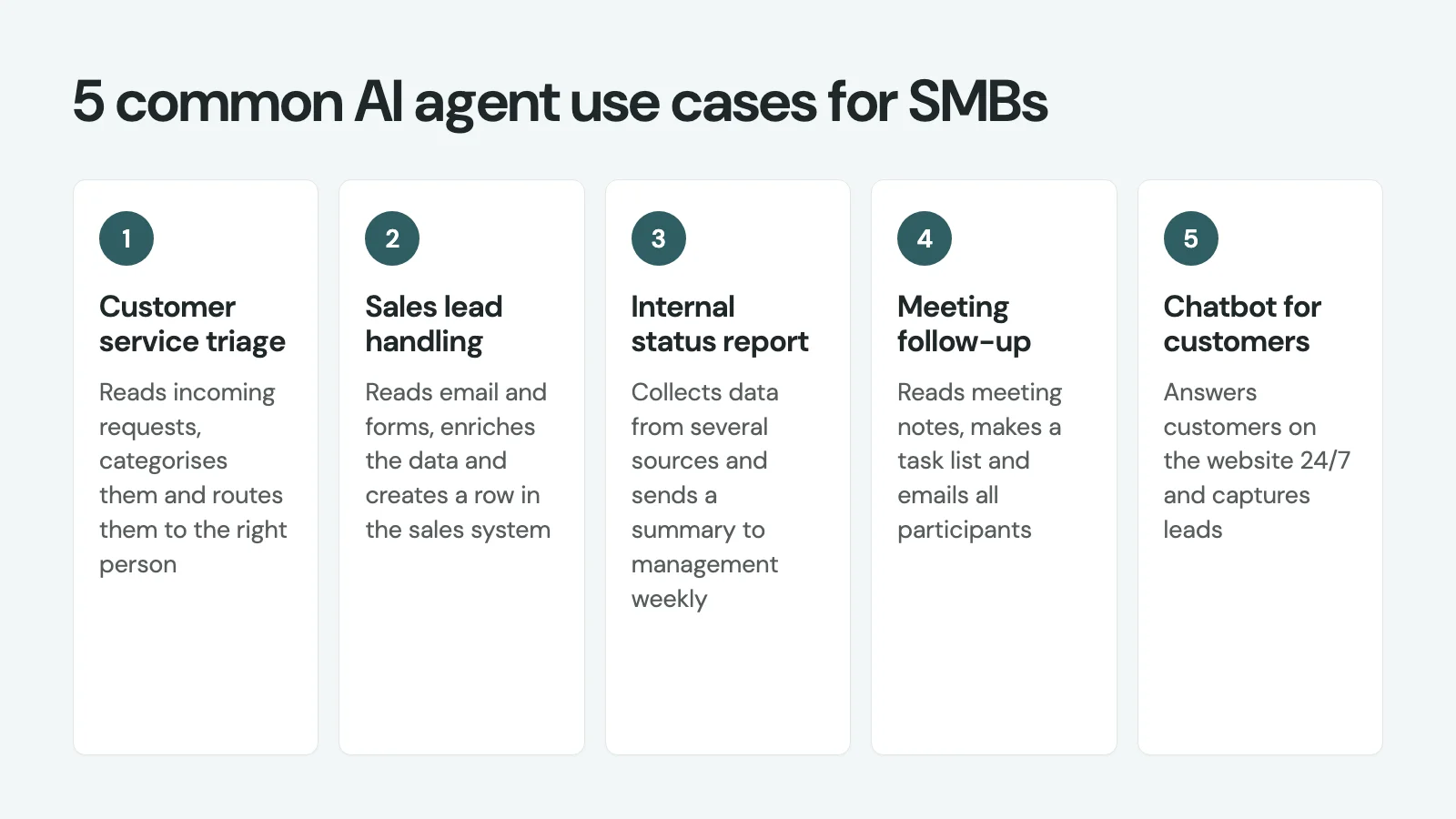
An AI agent for business is rarely a general-purpose tool. The best results come from defining one specific work process and building the agent around it. The most common places to start:
- Customer service triage: the agent reads incoming requests, categorises them, routes them to the right person or answers simple ones
- Sales lead handling: the agent reads email and forms, enriches them with data from the Norwegian business register (Brønnøysund) or the CRM, and creates a row in the sales system
- Internal status report: the agent collects data from several sources, writes a summary and sends it to the management team weekly
- Meeting follow-up: the agent reads meeting notes, makes a task list and sends a follow-up email to all participants
- Customer-facing chatbot: an agent on the website answers customers 24/7 and captures leads, like our AI chatbot for websites
Points 1–4 are well covered by ChatGPT Workspace Agents or Copilot Studio. Point 5 usually requires a custom solution with its own hosting and full control of the data.
When does a custom AI agent for business pay off?
ChatGPT Workspace Agents and Copilot Studio are powerful tools. But they have limitations that make a custom AI agent for business the better choice in some situations:
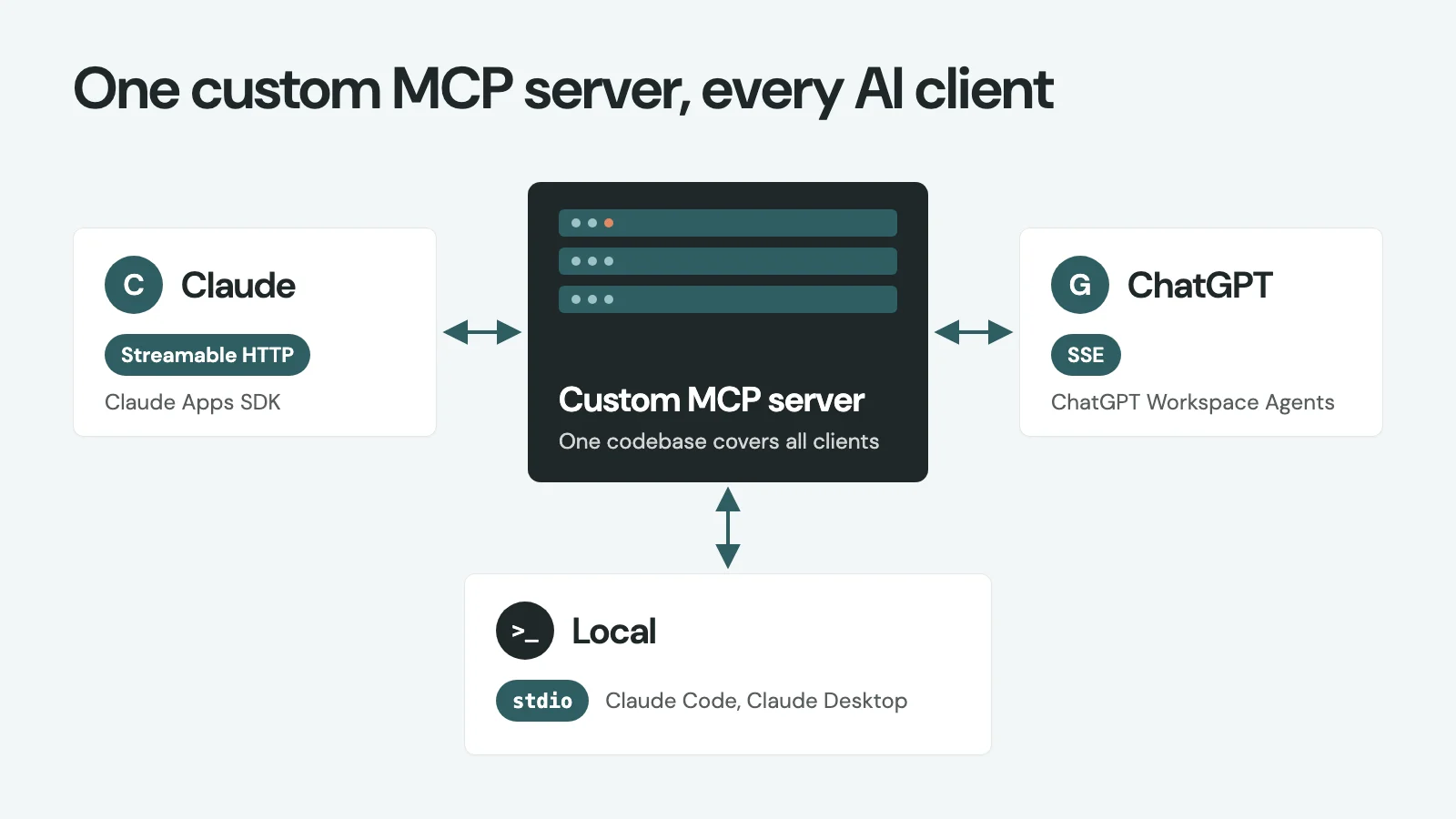
- Strict GDPR / EU data residency: ChatGPT data flows to the US. If you have to keep data in the EU, you need custom hosting (we use an EU region for our Nora agent)
- Customer-facing branding: Workspace Agents live in the ChatGPT interface, not on your website. A custom agent can carry your brand and UX
- Regulated industries: health, finance and legal have compliance requirements that ready-made platforms rarely meet
- Your own IP or a unique competitive advantage: a Copilot Studio agent looks the same for everyone who uses it. A custom one gives lasting differentiation
- Complex integration with your own systems: your own database, an internal API, a special user flow, all of which require your own development
For SMBs where none of these apply, ready-made platforms are usually faster and cheaper. But the five areas above often cover the most important use cases for B2B businesses in Norway.
How to get started with an AI agent for business
Three levels to start at, from simplest to most flexible:
Level 1: Test a ready-made platform (weeks 1–2)
Activate ChatGPT Business or Copilot Business if you do not have it already. Choose one work process. Build a simple agent without code. Measure the time saved over two weeks.
Level 2: Expand with more agents (months 2–3)
If level 1 delivers, create more agents for other processes. Check the cost: the credit model can explode at high volume.
Level 3: Consider custom (month 4+)
If you have use cases the ready-made platforms do not cover, or if the cost gets high, consider building custom.
What we have learned from building Nora
At Nettsmed we have our own AI agent for business, called Nora. It is live on nettsmed.no and captures sales leads through chat. It is built on Claude Haiku 4.5 (Anthropic), hosted in the EU, with the lead flow through Mailgun. We know first-hand what it costs, what works and what does not. That forms the basis for what we recommend to our clients.
Frequently asked questions about AI agents for business
What is the difference between an AI agent and an AI chatbot?
An AI chatbot answers customers on your website, often based on scripts. An AI agent for business can also take actions, call tools, and run autonomously over a long time, even when the user is offline.
How much does an AI agent for business cost in Norway?
From NOK 200 per user a month for a ready-made platform (ChatGPT Business, Copilot Business) to NOK 50,000–200,000 in one-off development for a custom agent. Running a custom agent typically costs NOK 500–3,000 a month.
Do I need developers to use an AI agent for business?
No, not for ready-made platforms such as ChatGPT Workspace Agents or Copilot Studio. These are no-code. For custom solutions with special requirements for hosting or integration you need a developer or a partner.
Is an AI agent for business GDPR-safe?
It depends on the provider. ChatGPT and Copilot store data in the US (with Standard Contractual Clauses). For sensitive data we recommend EU hosting through a custom solution. Check your data processing agreement before you expose customer data to an agent.
When should I wait before investing in an AI agent?
If you do not have a recurring work process that crosses several tools, or if the volume is very low (fewer than 5 tasks a week), an agent may be over-engineering. Start with one specific use case that actually causes friction.
The answer is generated from this page and has not been reviewed by us first.
Ready to consider an AI agent for your business?
An AI agent for business is no longer experimental technology. It is practical and available, but not always the right solution. We have built our own and can advise on what suits your business, based on your stack, your processes and your compliance requirements. Contact Nettsmed for a no-obligation assessment.
Shall we have a no-obligation chat?
Tell us where your business is heading, and we will show you how the website can take you there. You get honest advice whether or not you become a client.