GDPR for AI Agents: A Practical 7-Step Checklist (2026)
GDPR for AI agents (2026): a practical 7-step checklist covering data processing agreements, legal basis, DPIA and transfers to the US. Ready to start?
 Sindre Fjellestad · 8 min read
In this article (12)
AI agents process personal data in ways GDPR was not written for. GDPR for AI agents requires businesses in Norway to take concrete steps beyond an ordinary privacy policy: data processing agreements with providers outside the EEA, a DPIA for new types of agent, and openness about how the model trains on data. This guide gives you a practical 7-step checklist that takes you from idea to compliance in one afternoon. Norway is not in the EU, but GDPR applies in Norway through the EEA Agreement.
In brief: what GDPR requires of AI agents
Datatilsynet, the Norwegian Data Protection Authority, has been clear: AI is not exempt from GDPR. For Norwegian businesses that are considering or using AI agents (chatbot, sales agent, analysis agent, customer service bot), these seven minimum requirements apply:
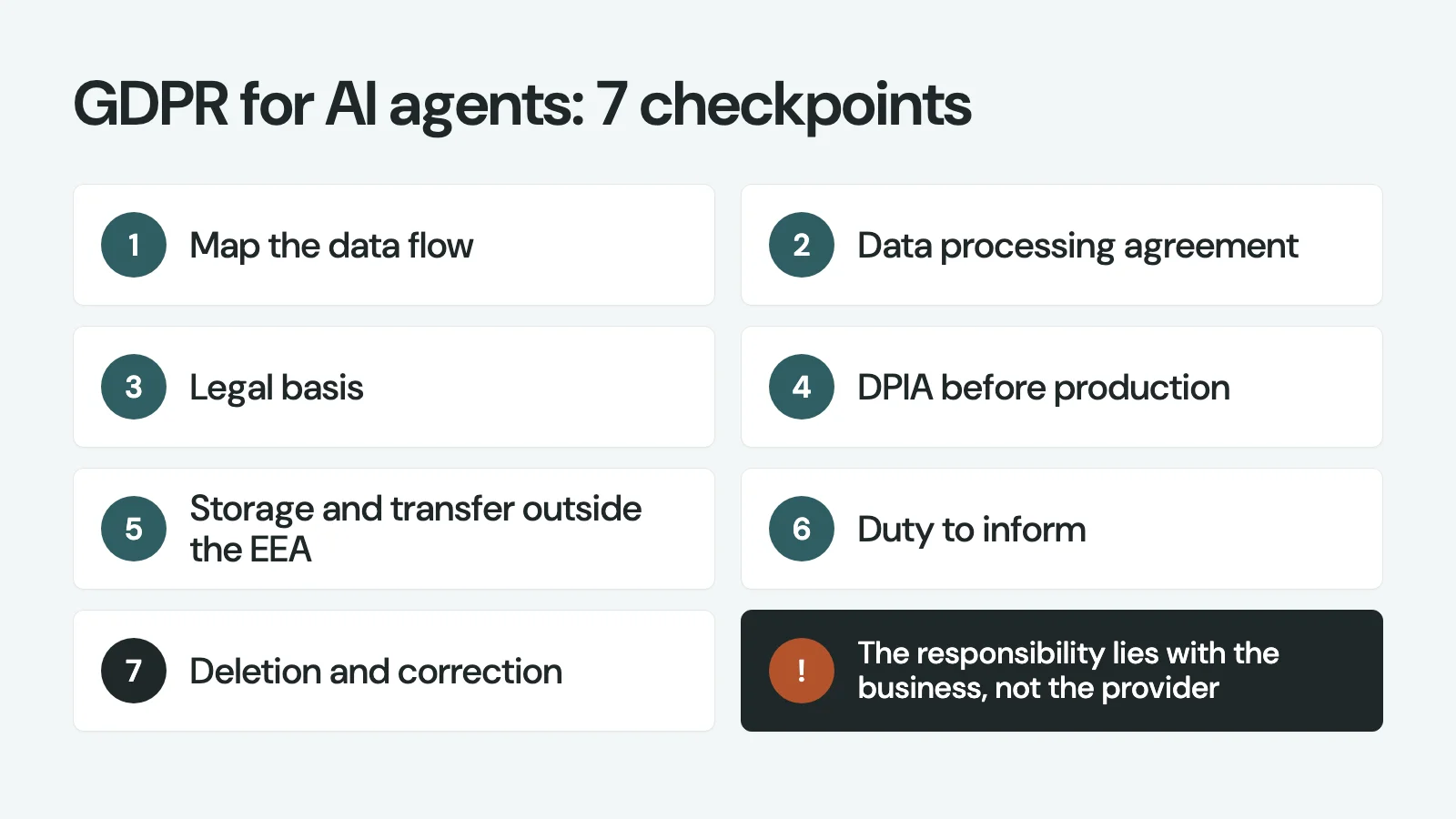
- Map the data flow: what you send in, what you get out
- A data processing agreement with the AI provider (Anthropic, OpenAI, Google)
- Choose a legal basis: consent, contract or legitimate interest
- A data protection impact assessment (DPIA) before production
- Data storage and transfers outside the EEA, especially to the US
- The duty to inform users
- Deletion and correction of data, also from the AI context
At Nettsmed we see that Norwegian SMBs often skip steps 2 and 4 because they assume "the provider handles it". It does not. GDPR for AI agents remains your responsibility.
Why AI agents challenge GDPR
Ordinary data processing has clear boundaries: data comes in, is stored somewhere and is used for a purpose. AI agents are different in four ways:
- The amount of data explodes: one agent conversation can capture more personal data than an entire web form
- The model can train on input: without an explicit opt-out, personal data can become part of the training data
- Decisions without human oversight: GDPR Article 22 sets special requirements for automated decisions
- The context is fluid: AI remembers, combines and reasons over data in ways the user does not expect
This is why GDPR for AI agents requires its own assessment, not just an adjustment of the existing privacy policy.
Checkpoint 1: Map the data flow
Before you write a single agreement, you need to know what actually happens to the data:
- What does the user send in? (Questions, documents, name, email, account number?)
- What does the AI see in the background? (CRM data, invoice history, employee information?)
- What does the AI produce? (Text, code, documents, decisions?)
- Where are input and output stored? (The provider's servers? Which country? For how long?)
Draw this as a data flow diagram with 5 boxes: user → input → AI model → output → storage. For each arrow between the boxes: what type of data, which legal basis, which retention period. This document is the foundation for everything else in GDPR for AI agents.
Checkpoint 2: A data processing agreement with the AI provider
If the AI agent uses Anthropic Claude, OpenAI ChatGPT, Google Gemini or another external model, you are the controller and the provider is the processor. You must have a signed data processing agreement (DPA) before you send a single byte of personal data. This is the core of GDPR for AI agents.
Check:
- Anthropic: a DPA is available through the Claude for Work portal (sign before production)
- OpenAI: ChatGPT Business and Enterprise have a DPA; free ChatGPT does not
- Google: Workspace + Gemini has a DPA through Workspace Admin
- Microsoft Copilot: DPA through the Microsoft Cloud Agreement
- Norwegian providers (hosted locally): a data processing agreement by email is sufficient
Red flag: are you using "free ChatGPT" for customer data? That is NOT GDPR compliant. Move to a paid version with a DPA first, then get started.
Checkpoint 3: Choose a legal basis
GDPR requires a lawful basis for processing personal data. For AI agents the three most common are:
- Consent (Article 6(1)(a)): the user actively ticks a box. Suitable for a chatbot on a public website
- Contract (Article 6(1)(b)): necessary to deliver the service the user has ordered. Suitable for customer service AI
- Legitimate interest (Article 6(1)(f)): a balance between the business's needs and the user's rights. Suitable for an internal analysis agent
Choose one basis per agent use case and document the choice. GDPR for AI agents requires that you can defend the choice if Datatilsynet asks.
Checkpoint 4: Carry out a DPIA
A data protection impact assessment (DPIA) is mandatory when the processing is likely to result in a "high risk" to the users' rights. AI agents often trigger the DPIA requirement because of:
- Automated decision-making (Article 22)
- Systematic monitoring of people
- Large-scale processing of sensitive data
The DPIA must contain: a description of the processing, an assessment of necessity, a risk analysis, and measures to reduce the risk. Datatilsynet has a template: use it. GDPR for AI agents triggers the DPIA requirement in 8 out of 10 real use cases we see.
When in doubt: do a DPIA. It is cheaper than an inspection.
Checkpoint 5: Data storage and transfers outside the EEA
Most of the big AI providers have servers in the US. After the Schrems II ruling and the European Commission's new adequacy decision (July 2023), data transfers to the US are allowed for companies certified under the Data Privacy Framework (DPF).
Check DPF status:
- Anthropic: DPF certified (since 2024)
- OpenAI: DPF certified
- Google: DPF certified
- Microsoft: DPF certified
If you use a smaller provider without DPF, you need other transfer safeguards (Standard Contractual Clauses + a Transfer Impact Assessment). This is the core of GDPR for AI agents when you use American providers.
For sensitive data (health data, religious beliefs, political views): consider an EU-hosted alternative or an entirely local model. The same logic applies to decision models such as Jev from TypeSafe AI: where the data ends up often decides the choice more than latency does.
Checkpoint 6: The duty to inform users
GDPR Articles 13 and 14 require you to inform users about:
- That they are communicating with an AI (not a person)
- Which data is processed
- The purpose of the processing
- How long data is stored
- Who receives data (providers, subcontractors)
- The user's rights (access, correction, deletion, complaint)
This must be in the privacy policy, and visible in the AI interface itself (typically "You are chatting with an AI from [company name]"). GDPR for AI agents requires extra openness because users often do not know they are interacting with a machine.
Checkpoint 7: Deletion and correction of data
The user's right to be forgotten (Article 17) also applies to AI agents. You must be able to:
- Delete all input and output linked to a user
- Prove that the data is no longer in the AI provider's logs
- Prevent deleted data from becoming part of the model's training data
In practice: use the AI provider's "no-train" flag (Anthropic Claude and OpenAI Business have this by default), and document the deletion routines. GDPR for AI agents requires deletion to be real, not just nominal.
Common mistakes with GDPR for AI agents in Norwegian businesses
We see these mistakes again and again:
- Using free ChatGPT for customer data: no DPA, no no-train, no GDPR
- Skipping the DPIA: "we are too small to need it". Datatilsynet disagrees
- Connecting an AI agent straight to the CRM without masking personal data: the agent sees more data than necessary
- The privacy policy mentions "AI tools" generically: it must name the provider and the purpose
- Forgetting the duty to inform in the interface: users think they are chatting with a person
- Storing the whole conversation history without a purpose: this breaks the data minimisation principle
At Nettsmed we help businesses in Norway build AI agents for business that meet GDPR from the start, not as an afterthought.
FAQ: common questions about GDPR for AI agents
Do I need a data processing agreement with Anthropic or OpenAI?
Yes, if the AI agent handles personal data. Anthropic Claude for Work and OpenAI ChatGPT Business/Enterprise have a DPA ready to sign. Free ChatGPT has no DPA and cannot be used for customer data.
Do we have to carry out a DPIA for every AI agent?
Yes, if the agent involves automated decisions, systematic monitoring or large-scale processing of sensitive data. Datatilsynet has a template: use it. When in doubt, do a DPIA.
Can we use American AI providers after Schrems II?
Yes, if the provider is DPF certified (Data Privacy Framework). Anthropic, OpenAI, Google and Microsoft are all DPF certified. For smaller providers without DPF you need Standard Contractual Clauses + a Transfer Impact Assessment.
How long can we store AI conversations?
Only as long as you have a lawful purpose. Common practice: customer service 30–90 days, internal analysis 6–12 months. Once the purpose is fulfilled, the data should be deleted (or anonymised). GDPR for AI agents requires a specific retention period per data category.
What about employee data, does GDPR apply there too?
Yes, GDPR also applies to employees' personal data. If an internal AI agent (HR bot, coding assistant) processes employee data, the same basis, openness and rights are required as for customer data. In addition, in Norway: the rules on monitoring and control in the Working Environment Act.
The answer is generated from this page and has not been reviewed by us first.
Ready to build GDPR-safe AI agents?
GDPR for AI agents is not a formality: it is a strategic advantage. Businesses that build compliance in from day one avoid having to tear down and rebuild when Datatilsynet starts asking questions.
We help SMBs in Norway design and implement AI agents that are compliant from the start. That means a data flow diagram, a DPIA template, provider agreements and a privacy policy that actually covers the AI use.
Get in touch with us for a no-obligation assessment: we give you a concrete GDPR status in 30 minutes, and a plan for the way forward.
Shall we have a no-obligation chat?
Tell us where your business is heading, and we will show you how the website can take you there. You get honest advice whether or not you become a client.